Questioning Grid

Provided by Jenny Pritchard

The questioning grid helps ensure that you are asking high order questions to students to challenge them within lessons. It can be used in a variety of ways:

  1. As a prompt on your desk to ask questions which provide the right level of support for the various groups/students/topics in your lesson
  2. As a tool for students to design their own questions and to understand the higher level requirements
  3. As a reflection of the questions that students ask about the lesson
  4. As a plenary – you could ask students to write a question about what they have learnt and ask for them to be within the synthesis area etc.
  5. A form of active revision for students.

This slideshow requires JavaScript.

Modelling Reading

Provided by Sarah Dukes.

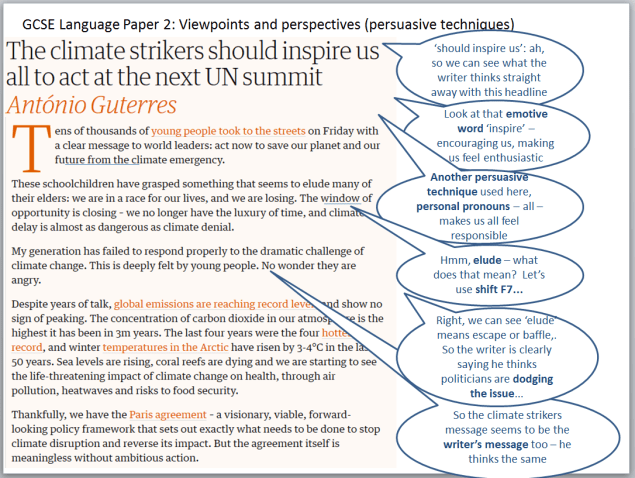
Modelled reading is a strategy which allows the teacher to explicitly demonstrate the process of reading by ‘thinking aloud’ about the strategies that are being used to decode words, comprehend meaning and read with fluency and expression.

Modelled reading involves students listening to a text read aloud by the teacher. The teacher models skilled reading behaviour, enjoyment and interest in a range of different styles of writing and types of text. It provides an opportunity for teachers to demonstrate their enjoyment in reading, and allows students to see a purpose in independent reading.

Modelling reading

For further information go to: https://www.education.vic.gov.au/school/teachers/teachingresources/discipline/english/literacy/readingviewing/Pages/teachingpracmodelled.aspx

You can also find more information in the CPD folder on Staff Academic.
Socratic debate

Provided by Sarah Dukes

Socratic Debate is a form of cooperative argumentative dialogue between individuals, based on asking and answering questions to stimulate critical thinking.

In a Socratic debate, students help one another understand a key idea / concept / text through a group discussion format. Students are responsible for facilitating their group discussion, whilst also practicing how to listen to one another.

Format: inner and outer circle.  Inner circle lead discussion; outer circle participate through listening.  Each pupil on outer circle gets a ‘focus card’ with a particular skill to concentrate on (this can be linked to the overall skills within the text, or a skill linked to listening and debating – see examples).

Inner circle – read through the text.  Give them a question to start them off.  They lead the discussion.

  • Teach listening skills before
  • Give students time to prepare – this can involve reading and annotating a text, writing down key questions, researching a topic etc.
  • Give all students an overall objective or learning question to focus their discussion, and encourage them to try and reach an agreement.
  • Stick to the rules – outer circle (and teacher) wait to be invited into the discussion; inner circle lead: don’t mind awkward silences at first.
  • Have back-up questions ready
  • Incorporate time to reflect and evaluate on both S&L skills, but also on the content of the debate.

You can find more information in the CPD folder on Staff Academic.